

Difference between...

This is a very interesting topic. When you grow up speaking spanish, you don't even notice how confusing this is. But it is! So I'll explain this as simple as possible. Don't worry about it :)
- Ser implies an inherent thing/characteristic.
- Estar implies temporality, change.
That is the main idea of this. Now, let's see some examples on the uses of them:
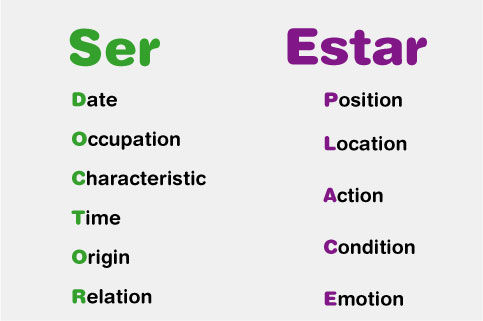
Now let's try sentences!
SER:
- Date: Today is November 30 / Hoy es 30 de noviembre.
- Occupation: She is a doctor / Ella es doctora.
- Characteristic: The chair is blue / La silla es azul.
- Time: It is 5 o'clock / Son las 5 en punto.
- Origin: They are from Spain / Ellos son de España.
- Relation: He is my boyfriend / Él es mi novio.
As you can see, these are things that, even though they can change (like the time, ocuppation), you either are or you aren't, there is no in between. Those are permanent states.
ESTAR:
- Position: The book is in the table / El libro está en la mesa.
- Location: She is in Argentina / Ella está en Argentina.
- Action: I am eating pizza / Estoy comiendo pizza.
- Condition: That person is very sick / Esa persona está muy enferma.
- Emotion: My grandparents are very happy / Mis abuelos están muy felices.
The main characteristic is that all of these are temporary states.
Now check this out:

You can see how to write "ser" or "estar" (infinitive) depending on the person you are talking about.
And that's about it! Just think about it, is it a permanent or a temporary state? Is it an inherent characteristic or not? You know what to do now!
If you have any questions let me know! Also, if you want me to write about a particular topic, write it in the comments :)

This DOCTOR - PLACE abbreviation will be really useful. I used to remember that ser is for something permanent and estar for something not permanent, but then I keep using ser for location. Thanks for sharing this!
I'm glad :)
If you want me to write about any particular topic just let me know.
if talking about happy "feliz", I keep seeing sentences "él es feliz" and not "él está feliz". Isn't happy an emotion?
It is! Very good question. The thing is, when you listen to "es feliz" talks about a long-term happiness, not a temporary emotion about one particular event. "Está feliz" means that the person is happy in that particular moment of time, but "es feliz" means that the person has long-term happiness, is a happy person overall.