Types of words in Spanish

What is a tonic syllable?
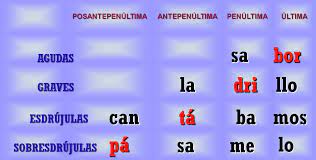
It refers to the syllable pronounced with bigger emphasis or stress within a word. Depending on the location of the tonic syllable, the meaning of the word can change completely. So, according to the position of the tonic syllable we can identify four types of words:
- Agudas: Words with stress on the last syllable. They do not have a "tilde (´)" unless they end in a vowel, "n" or "s".
- Graves: Words with stress on the second to last (penultimate) syllable. They do not have a tilde unless there is an excepction to the general accentuation rules.
- Esdrújulas: Words with stress on the antepenultimate syllable. They ALWAYS have a tilde.
- Sobreesdrújulas: Words with syytess before the antepenultimate syllable. They ALWAYS have a tilde.
I know this sounds like a tongue twister! But don't worry, examples will make it easier to understand. The syllable in bold is the one with the stress.
- Agudas: Coffee/Ca-FÉ , Talk/Ha-BLAR , Animal/A-ni-MAL , Baby/Be-BÉ , French/Fran-CÉS.
- Graves: Tree/ÁR-bol , Pencil/LÁ-piz , Leader/LÍ-der, Sugar/A-ZÚ.car
- Esdrújulas: Fast/RÁ-pi-do , Music/MÚ-si-ca , Page/PÁ-gi-na , Camera/CÁ-ma-ra
- Sobreesdrújulas: Fastly/RÁ-pi-da-men-te, Eat it/CÓ-me-te-la, Tell me/DÍ-ga-me-lo
These accentuation rules are super important, because they help to distinguish between words that are spelled similarly, but have different meanings. How do you tell the difference between them?
TILDES!
- Él (he) , El (the).
- Más (more), mas (but).
- Tú (you), tu (your).
- Sí (yes), si (if).
- Por qué (why), porque (because).
- Papá (dad), papa (potato).
Those are some examples on how the meaning can completely change depending on the tilde. That is the reason why is so important!
If you have any questions regarding this, I'm happy to help.
Let's practice!
In the comments, categorize these words (aguda, grave, esdrújula, sobreesdrújula):
Clóset, Mamá, Capitán, Limón, Lámpara, Bahía, Botón, Específicamente.
Good luck! :)